Saturday, February 24, 2007

Thursday, February 22, 2007
Wednesday, February 14, 2007
Batteries
Battries
Not all batteries need acid. There are many lead based batteries like:
- nickel-iron
- nickel-zinc
- Nickel-metal Hydride
- Nickel-Cadmium
- Lithium Ion
- lead calcium
- lead antimony
- AGM(Abosrbed Glass Mat Battery)
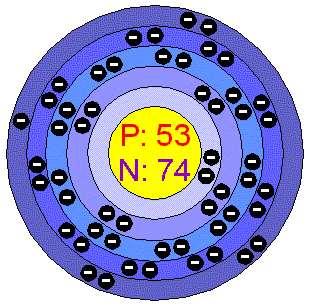
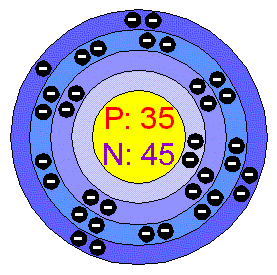
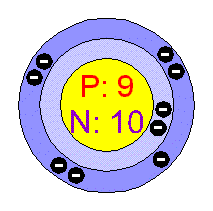
Bohr Model
 The filling order (up to the elements in 20 Calcium is:
a)Two electrons in the first shell, maximum.
b)The next shell has up to eight electrons.
c)And also eight electrons for the next shell.
Dissolving, Concentration, Evaporation, Crystallization
Dissolving
-Is when particles diffuse through the liquid.
-This is a physical change NOT a chemical change.
For example when something like a sugar cube put in hot water, the particles slowly diffuse through the water. When it completely dissolves there is no solid left. This making the water know a solution.
Concentration
-This happens after dissolving.
If there is one sugar cube in a glass of hot water and it dissolves it is less concentrated. Or the solution has more dilute. But if there are three sugar cubes dissolved in a glass of water the solution has a higher concentration of solute.
Evaporation and Crystallization
Salt water can evaporate with time making the salt solution more concentrated. Eventually all the water will evaporate crystals of salt will begin to form called crystallization.
Distillation

The water evaporates, but the salt does not. On the side arm water vapours start to condense. This Fractional Distillation is good for separating solutions and recovering the liquid. There are different separation methods like evaporation or filtering.
Monday, February 12, 2007

Chromatography
The picture shows what a dot of felt pen on paper looks like when put in a beaker of water. It literally shows you the different colours mixed into this pens ink that's making the orange colour.
Settling Materials
Dirt in water settles, it is a example of a settling material.
Separation using Magnetics
Iron and sulphur=iron and aluminum
Filtration
Filters are all around you, especially in your kitchen. Ex. coffee, water, furnace, juices, sewage treatment, atmosphere.
States of Matter
Matter=is an object with mass and volume.
Solid- The particles squished together, slightly vibrating. The particles have broken natural bound but still are close together.
Liquid-There is more vibration between the particles and their natural bound is broken apart. (Vibration tends to force objects apart.) A Solid to a liquid is caused when more energy(vibration) is added.
Gas-The particles are know independent(no interaction) and are moving more faster. A liquid becomes a solid when more energy(vibration) is given to an object.
Solid- The particles squished together, slightly vibrating. The particles have broken natural bound but still are close together.
Liquid-There is more vibration between the particles and their natural bound is broken apart. (Vibration tends to force objects apart.) A Solid to a liquid is caused when more energy(vibration) is added.
Gas-The particles are know independent(no interaction) and are moving more faster. A liquid becomes a solid when more energy(vibration) is given to an object.
States of Matter
Pure substance
- some properties throughout
- constant compositions
- homogenise
- one type of particle(atom)
Element
- one type of atom
- cannot be broken down into simpler pieces
- found in periodic table
- H, He, Li, N, CO, Ne
Compound
- mode of two or more elements
- can be broken down
- some properties thorough out
- different properties from properties of the individual atoms
- Na Cl, Na1,H2O
Mechanical mixture
- can see individual pieces by eye
- salad, pizza
Subscribe to:
Posts (Atom)